Top 10 Grocery Delivery App Development Companies for Startups and Enterprises in 2026
335 Views
13min
January 12, 2026
Last Updated: January 21, 2026
Boost Your Businesswith AI Powered Products!
Enter your details for expert insights and a personalized action plan.
Share
The way people buy groceries has changed, and it’s not going back. What used to mean store visits and checkout lines now happens on a phone, often in a few minutes. Grocery shopping has quietly become digital, and for many customers, that’s now the default.
Online grocery delivery is no longer a side option. Global online grocery sales is expected to reach $1.42 trillion by 2029 and the numbers keep climbing. People expect groceries to arrive quickly, without confusion or delays. They want clear pricing, reliable delivery times, and an app that simply works. When those basics are missing, users don’t complain. They uninstall.
If you’re planning to launch a grocery delivery app in 2026, the challenge goes beyond building features. The real question is whether the app feels reliable enough for everyday use. That depends heavily on who builds it. The right grocery app development company helps you create an experience customers trust and return to. The wrong choice often results in an app that launches on time but never gains traction.
Benefits of Developing a Grocery Delivery App
A grocery delivery app is more than a digital storefront. When built well, it becomes the system that connects customers, operations, and long-term growth. This is why businesses across regions are working with grocery delivery app development companies to strengthen how they sell and scale.
1. Reach Customers Anytime, Anywhere
Customer behavior has shifted quietly but permanently. People order groceries when it suits them, not when stores are open. A mobile app keeps your business available throughout the day, across locations, without expanding physical space. For brands planning to build a grocery delivery app, this kind of accessibility levels the playing field between local stores and national chains. Many grocery app development companies list 2026 trends showing that convenience, not discounts, drives repeat usage.
2. Increase Revenue With On-Demand Ordering
A grocery app doesn’t just replace in-store purchases. It adds new revenue layers. Delivery fees, express slots, subscriptions, and partner promotions contribute steadily over time. Businesses using on-demand grocery app development services often see higher order frequency because customers reorder essentials with less friction. This model has worked well for platforms investing in grocery app development, where fast fulfillment encourages smaller but more frequent purchases.
3. Build Customer Trust With Real-Time Updates
Trust matters more than speed alone. Real-time order status, delivery tracking, and accurate arrival windows reduce customer frustration. These features are now standard expectations, not extras. When businesses hire grocery delivery app developers who understand logistics flows, the result is fewer complaints and stronger customer retention.
4. Personalize Shopping Using AI Insights
Apps collect useful data naturally. Purchase history, order timing, and preferences help businesses understand customers better. With AI-powered grocery app development, simple recommendations and reminders make shopping easier without feeling intrusive. Suggesting frequently bought items or timely reorders increases basket size while improving user experience.
5. Improve Operations Behind the Scenes
For businesses, the biggest gains often happen off-screen. Inventory sync, automated order routing, and vendor coordination reduce manual effort. The best grocery app development agency focuses as much on backend efficiency as customer-facing design. This is especially important for grocery app development for startups that need to scale without operational overload.
6. Compete More Effectively in a Crowded Market
The grocery space is busy, but not every app performs well. Businesses that invest in the right technology early gain stability and flexibility later. Working with a grocery delivery app development company that understands local delivery patterns, pricing pressure, and fulfillment challenges helps brands stand out through reliability rather than noise.
Top 10 Grocery Delivery App Development Companies in 2026
Finding the right partner to build your grocery delivery app is more than picking a name off a list. The best companies understand your users, your business goals, and the operational challenges of running a grocery platform. Some are great for a quick launch, others shine at handling complex, high-volume operations, and a few combine speed, customization, and scalability.
Here’s a closer look at the top grocery delivery app development companies in 2026, with a focus on their strengths, what kind of business they serve best, and why they stand out.
1. Quickworks
Quickworks is known for delivering multi-vendor grocery delivery platforms that balance speed, reliability, and scalability. They offer both white-label solutions for rapid launches and fully custom apps with source code for businesses that want complete control.
Why Choose Quickworks:
Hyperlocal grocery delivery apps that handle high order volumes
AI-powered recommendations and loyalty programs built-in
Free consultation and audits to validate your idea before development
Strengths:
Custom grocery app development for startups and enterprises
Scalable architecture that grows with your business
Advanced features like predictive analytics
Best For: Startups testing the market or enterprises planning long-term expansion
2. Apptunix
Apptunix is a global software firm that focuses on enterprise grocery app development services. They’re experts at building platforms that handle complex logistics, multiple cities, and large user bases.
Why Choose Apptunix:
Handles high-volume orders and multi-city operations
Integrates inventory management, loyalty programs, and payment systems
Provides robust analytics and real-time tracking
Strengths:
Enterprise-grade, scalable grocery platforms
Custom solutions tailored to operational complexity
Strong backend architecture
Best For: Large grocery chains or enterprises with complex operational needs
3. Mobrilz
Mobrilz specializes in cross-platform mobile apps, focusing on smooth, user-friendly grocery experiences. Their apps work seamlessly on iOS and Android, which is perfect for startups and regional operations.
Why Choose Mobrilz:
Mobile-first design with intuitive UX
Optimized for regional launches before scaling nationally
Strengths:
Cross-platform apps that work on multiple devices
Smooth delivery workflows
Focus on usability and speed
Best For: Regional grocery chains and growing startups
4. CQLSYS
CQLSYS has a reputation for building stable and reliable grocery delivery apps. They prioritize backend integrity, order accuracy, and performance under heavy loads rather than experimenting with flashy features.
Why Choose CQLSYS:
Ensures consistent performance even at scale
Focus on reliability over rapid feature rollout
Strengths:
Reliable grocery delivery platforms
Strong backend systems for multi-vendor management
Accurate order tracking
Best For: Businesses where smooth daily operations are critical
5. Concetto Labs
Concetto Labs balances cost, performance, and essential features. Their solutions include admin dashboards, inventory management, and reporting tools, helping startups avoid unnecessary complexity early on.
Why Choose Concetto Labs:
Clear, structured approach for early-stage projects
Easy to scale features as your business grows
Strengths:
Custom app development with controlled scope
Admin dashboards and inventory sync
Cost-effective development
Best For: Startups that want clarity on cost, timeline, and essential features
6. SDLC Corp
SDLC Corp focuses on delivery management and process efficiency. Their apps include user, driver, and admin interfaces and emphasize workflow clarity and predictable timelines.
Why Choose SDLC Corp:
Strong focus on structured execution and logistics
Ensures smooth operations for both customers and delivery partners
Strengths:
Clear workflows for drivers, restaurants, and admins
Delivery management systems
Predictable development and launch timelines
Best For: Businesses that value process, structure, and operational reliability
7. ValueAppz
ValueAppz specializes in white-label grocery apps that let startups launch quickly with essential features. It’s perfect if you want to test the market without investing heavily upfront.
Why Choose ValueAppz:
Quick setup with minimal development time
Covers core grocery delivery features like ordering, payments, and notifications
Strengths:
Ready-to-launch white-label platforms
Fast deployment for local or small-scale operations
Simple, reliable systems
Best For: Small grocery stores or startups entering the market quickly
8. SoluLab
SoluLab builds enterprise-grade, scalable grocery apps with personalization, analytics, and multi-city support. They’re great for companies expecting rapid growth and high demand.
Why Choose SoluLab:
Handles complex operations with advanced integrations
Offers analytics, personalization, and AI features
Strengths:
Enterprise-level scalability
Multi-city support
Advanced tech integrations
Best For: Enterprises planning expansion or apps with large user bases
9. Binary Studio
Binary Studio takes an engineering-first approach, building flexible, secure, and maintainable grocery platforms. Their solutions are usually custom-built to last long-term.
Why Choose Binary Studio:
Focus on security, flexibility, and maintainability
Suitable for enterprises with complex workflows
Strengths:
Custom architecture for complex apps
Enterprise-grade backend systems
Long-term support and scalability
Best For: Businesses with technical complexity and long-term plans
10. Oyelabs
Oyelabs helps startups launch MVP grocery apps quickly. Their focus is on usability, reliability, and market testing before scaling.
Why Choose Oyelabs:
Ideal for startups testing user demand
Provides functional, reliable apps without overbuilding
Strengths:
On-demand grocery apps
MVP-focused development
Simple, functional design
Best For: Startups entering the market fast without heavy investment
Hyperlocal grocery app development, ,long-term maintainable platforms at gobal level
Mobrilz
Growing Businesses
Cross-platform development
Regional grocery delivery apps
Launching in multiple regions with moderate scale
CQLSYS
Mid-sized Businesses
Stable backend systems
Core grocery delivery platforms
Businesses focused on reliability over experimentation
Concetto Labs
Startups & SMBs
Custom builds with controlled scope
Custom grocery delivery app solutions
Testing market demand with limited budgets
SDLC Corp
Process-driven Teams
Delivery workflows, logistics
Multi-app grocery systems
Businesses prioritizing structured execution
ValueAppz
Small Businesses
White-label grocery apps
Ready-made grocery delivery apps
Fast launch with minimal customization
SoluLab
Enterprises
Scalable architecture, personalization
Instacart-like grocery platforms
High-volume, multi-city grocery operations
Binary Studio
Enterprises
Custom engineering
Enterprise grocery delivery systems
Complex integrations and long-term maintenance
Oyelabs
Early-stage Startups
Simple, functional apps
Basic grocery delivery apps
Local or city-level grocery delivery
How Much Does It Cost to Build a Grocery Delivery App in 2026?
If you’re exploring grocery delivery app development cost, it’s important to understand that not all apps are created equal. The price depends on whether you’re building an MVP, an advanced app, or an enterprise-grade platform. Your choices around features, design, platform, and integrations directly impact the final figure.
MVP vs Advanced vs Enterprise
An MVP is your minimum viable product—the app has essential features like product listing, order placement, and basic delivery tracking. This is ideal for startups testing the market. The cost to build a grocery delivery app at this stage is typically lower, but it’s important to prioritize usability and reliability over flashy features.
An advanced app includes additional features like AI recommendations, loyalty programs, multi-vendor support, and more sophisticated payment integrations. It’s suited for growing businesses ready to capture more market share and provide a richer user experience.
Enterprise apps are full-scale platforms designed to handle large volumes of orders, multiple regions, and complex logistics. They often include enterprise grocery app development features like advanced analytics, dynamic pricing, robust dashboards, and vendor management. Naturally, this level comes with a higher grocery delivery platform for enterprises cost but also offers the highest ROI and scalability.
Quickworks’ Lifetime Pack Options
At Quickworks, we understand that every business has different goals and budgets. That’s why we offer flexible ownership options for your grocery delivery app. By offering these packages, Quickworks makes it easy for both startups and enterprises to build a grocery delivery app that fits their needs, budget, and long-term growth plans.
Quickworks keeps pricing transparent and ROI-focused. We start by evaluating your business goals, target audience, and feature set. Instead of just quoting a number, we provide a roadmap showing what’s achievable at MVP, advanced, and enterprise levels, helping startups and enterprises alike make informed decisions. Our white-label grocery delivery app solutions allow faster deployment without compromising quality, and our team of grocery app developers ensures your project scales smoothly.
✅Annual Pack (No Source Code) – Starts at $4,000
This option gives you a fully functional, ready-to-launch app with all the essential features, real-time tracking, AI recommendations, and multi-vendor support. It’s ideal for startups who want to launch quickly without worrying about managing the codebase.
✅Lifetime Pack (Full Ownership with Source Code)– $20,000
For businesses looking for complete control and flexibility, you can purchase the full product along with the source code. This allows your team to customize, scale, or enhance the app in the future without limits.
Quick Tip: Avoid These Common Grocery App Development Mistakes
Even experienced teams sometimes fall into the same traps when choosing grocery delivery app development companies. Avoiding these mistakes can save time, money, and customer trust. Here’s what to watch out for and how Quickworks ensures your app succeeds:
❌Ignoring UX for First-Time Users
First impressions matter more than you think. A confusing menu, cluttered product listings, or a complicated checkout can turn first-time users away instantly. Quickworks focuses on intuitive onboarding, clean UI, and frictionless checkout, guiding users naturally from browsing to purchase. For example, our apps often include features like predictive search and one-tap reordering, so even new users feel confident navigating the platform.
❌Overcomplicating Features in MVP
Startups often make the mistake of packing too many features into an MVP. It seems appealing, but it can overwhelm users and inflate development costs. Quickworks recommends a phased approach: start with essential features like product listing, order placement, and basic delivery tracking. Once the app gains traction, we introduce advanced capabilities such as AI recommendations, multi-vendor support, or loyalty programs.
❌Not Planning for Scalability
Many apps work perfectly for a small user base but crash under real-world demand. An app handling 100 daily orders may fail when scaling to 10,000. Quickworks solves this with scalable architecture, cloud-based backends, and modular systems, so the platform can grow seamlessly. Whether expanding to new cities, adding vendors, or handling peak shopping hours, your app stays stable and reliable.
❌Lack of Analytics and Reporting
Without data, you’re operating in the dark. Understanding customer behavior, peak order times, or churn patterns is critical to optimizing operations. Quickworks integrates custom dashboards and analytics tools, giving enterprises real-time insights into orders, revenue, user behavior, and delivery performance. This allows proactive improvements and smarter business decisions.
❌Skipping Real-Time Inventory Integration
Nothing frustrates a customer more than ordering a product only to find it’s out of stock. Grocery delivery app development companies ensure real-time inventory synchronization with vendors and warehouses. This not only maintains trust but also reduces wasted deliveries and refunds. For multi-vendor apps, this is especially crucial to keep all vendors’ listings accurate.
❌Weak Payment and Security Setup
A failed payment or security breach can destroy user confidence overnight. Quickworks implements secure payment gateways, PCI-compliant processing, and encryption best practices, ensuring every transaction is safe and reliable. From digital wallets to credit cards and UPI, users experience smooth, trustworthy payments without fear of data breaches.
❌Neglecting Performance Optimization
Slow-loading apps lose users fast. Even minor lags during browsing or checkout can reduce conversion rates. Quickworks focuses on performance optimization, lightweight coding, and efficient server calls so that the app runs smoothly even during peak hours.
❌Ignoring Customer Support Integration
Delivery issues, refunds, or product queries are inevitable. Apps without integrated support frustrate users and reduce retention. Quickworks builds in-app support channels, chatbots, and ticketing systems to quickly address problems, keeping customers satisfied and loyal.
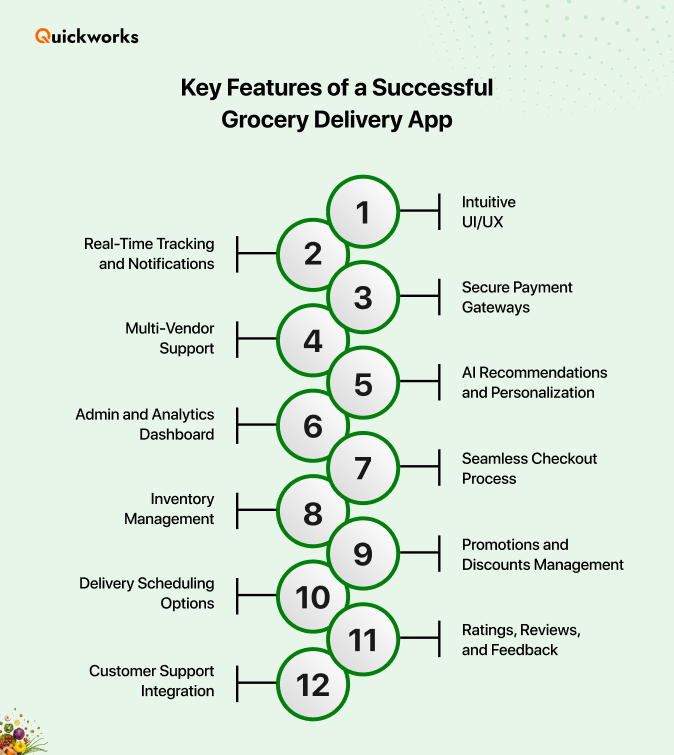
Building a grocery app is about creating an experience that keeps customers returning. The best grocery delivery app development companies combine convenience, speed, and personalization. Here’s a detailed look at 12 essential features every successful grocery delivery app should include:
1. Intuitive UI/UX
Customers want shopping to feel effortless. Clear categories, simple search, and minimal clicks from browsing to checkout are key. Even small UI improvements, like predictive search or one-tap reordering, can increase order frequency.
2. Real-Time Tracking and Notifications
Order transparency builds trust. Users want to know exactly when their groceries will arrive and receive notifications for status changes. This reduces anxiety and increases repeat usage.
3. Secure Payment Gateways
Offering multiple payment options is standard, but security is non-negotiable. Apps must integrate encrypted payment processing to protect customer data while supporting credit/debit cards, wallets, and UPI systems.
4. Multi-Vendor Support
If your platform allows several local vendors, it should handle different inventories, pricing, and delivery areas without confusing the customer. This feature is critical for marketplaces and enterprise-grade apps.
5. AI Recommendations and Personalization
AI can suggest products based on past purchases, browsing history, and even seasonal trends. Personalized suggestions increase basket size and improve user satisfaction. This is where AI-powered grocery app development adds real value.
6. Admin and Analytics Dashboard
A dashboard that tracks orders, vendor performance, peak hours, and churn rates helps grocery delivery app development companies make data-driven decisions and optimize operations.
7. Seamless Checkout Process
A long or complicated checkout flow kills conversions. Features like saved addresses, quick cart edits, and one-click payments reduce friction and encourage repeat purchases.
8. Inventory Management
Real-time inventory tracking ensures that customers only see products that are available. It also allows vendors to update stock dynamically and prevents overselling or customer disappointment.
9. Promotions and Discounts Management
Built-in tools for coupons, flash sales, or membership discounts help drive engagement and increase order frequency.
10. Delivery Scheduling Options
Allowing customers to select delivery times or slots adds flexibility. This is particularly valuable for busy professionals or families who plan ahead.
11. Ratings, Reviews, and Feedback
Customer reviews influence buying decisions. A grocery app that enables rating products and vendors builds trust and helps maintain quality.
12. Customer Support Integration
In-app chat, help desks, or call options improve customer experience and ensure issues are resolved quickly. Even a small delay in resolving a problem can impact customer loyalty.
Why Startups and Enterprises Should Partner with Quickworks?
When it comes to building a grocery delivery app, the right grocery delivery app development companiescan be the difference between success and a costly misstep. Quickworks is a top-leading grocery delivery app development company that blends experience, strategy, and execution to deliver apps that actually perform in the real world.
Our expertise spans industries, geographies, and business sizes. We understand the challenges of hyperlocal delivery in dense urban markets and the complexities of enterprise-grade multi-city operations. We know that a grocery app is about ensuring reliability, speed, and a frictionless experience for every customer, every time.
Who We Are
Quickworks is a leading grocery delivery app development company in USA that helps startups and enterprises bring their app ideas to life. We specialize in custom grocery app development, building fast, scalable, user-friendly apps. Our team combines deep technical expertise with practical business knowledge, ensuring your app thrives in real-world markets.
With years of experience across multiple industries, we understand the challenges of hyperlocal delivery, multi-vendor marketplaces, and enterprise-grade platforms. We focus on creating solutions that are easy for customers to use, efficient for vendors, and flexible for business growth.
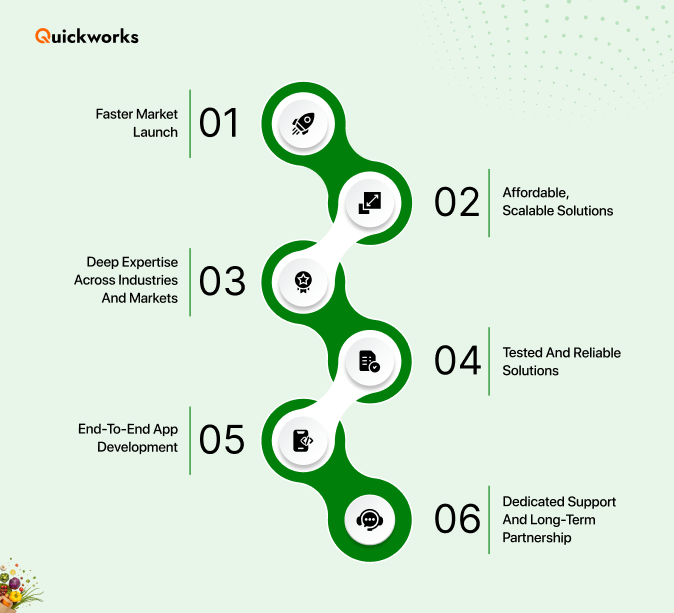
Faster Market Launch
Time is critical in the grocery delivery business. Quickworks helps you launch your app quickly without cutting corners. With ready-to-use frameworks, tested modules, and Blinkit-like MVPs, startups can test the market fast, capture early users, and start generating revenue before competitors move. Speed doesn’t mean compromise—we deliver quality apps that are ready for real-world use from day one.
Affordable, Scalable Solutions
Building an app doesn’t have to break the bank. Quickworks offers flexible pricing options for startups and enterprises alike. From lifetime packs starting at $4K to full ownership with source code at $20K, our solutions are designed to be cost-effective yet powerful. You get maximum value without sacrificing features, performance, or scalability.
Deep Expertise Across Industries and Markets
We understand that grocery apps work differently depending on business size and region. Quickworks builds apps that are fast, reliable, and user-friendly, making sure every customer has a smooth experience whether they order once a month or daily.
Tested and Reliable Solutions
With years of experience, we provide solutions that are proven in the market. Our apps handle thousands of simultaneous deliveries, integrate with real-time inventory, and come with AI-powered recommendations and analytics dashboards. You’re not experimenting with untested tech—we deliver apps that work from day one.
End-to-End App Development
Quickworks covers every stage of development, so you don’t need multiple vendors. Startups get MVPs for fast market entry, while enterprises receive scalable, enterprise-ready apps capable of handling high traffic.
Dedicated Support and Long-Term Partnership
We don’t just build your app and leave. Quickworks provides ongoing support, strategic guidance, and optimization to ensure your app grows with your business. From updates to scaling features and adding new vendors, we’re your partner every step of the way.
Conclusion
The grocery delivery market is moving fast, and every day, new apps are grabbing attention, attracting customers, and earning revenue. If you wait too long, competitors could get ahead while your idea stays on the shelf. There’s huge potential here—hyperlocal delivery, AI-driven personalization, and multi-vendor platforms are changing how people shop for groceries.
Picking one of the top grocery delivery app development companies is a business decision that can shape your success. The right partner can create an experience that keeps users coming back, increases orders, and grows with your business.
Quickworks stands out because we combine industry experience, AI-powered features, hyperlocal delivery know-how, and scalable systems all in one place. Startups can launch quickly, test ideas, and get a head start before competitors catch up. Enterprises can roll out apps that handle thousands of users and deliveries without stress.
Whether you want to build a grocery app from scratch or upgrade your current platform, Quickworks makes sure your project is built to grow, engage users, and succeed in the long run.
Don’t let your idea wait while the market moves—partner with Quickworks and take the lead.
Frequently Asked Questions(FAQs)
Costs vary depending on features, platform, and complexity. Quickworks offers MVP options starting at $4K and full ownership with source code for $20K.
An MVP can be developed in 2–6 weeks, advanced apps in 8–15 weeks, and enterprise-grade platforms in 15–30 weeks.
We use React Native, Node.js, Firebase, AI/ML integrations, and cloud-based backend solutions to build scalable, fast, and secure grocery apps.
Absolutely. Quickworks designs multi-vendor grocery app platforms with real-time inventory management, order tracking, and vendor dashboards.
Yes. We provide enterprise grocery app development with advanced analytics, AI recommendations, and scalability to support thousands of orders across multiple cities.
Yes. We offer full post-launch support, updates, and maintenance, ensuring your grocery app continues running smoothly and evolves with your business.
Chubby & Enthusiastic! Proficient in marketing research and statistical analysis. Highly creative with my thoughts about the latest mobile and web advancements. Dwell up the tech world with my glasses :)
Subscribe to Get Search Free Updates on Upcoming Tech Stories.
You Tell Us the Destination, and We Will Lead the Way for You
We Are a Global Leader in New Age Digital Product Development.




 January 12, 2026 Last Updated: January 21, 2026


 Phone Number:
  Email: